
The Thirty-Second Clock and the Thirteen-Nation Gap: Where the Real Question Sits Before the 2026 Commonwealth Kabaddi Championship
**মূল উত্তর:** কমনওয়েলথ কাবাডি চ্যাম্পিয়নশিপ ২০২৬ একটি প্রথমবারের টুর্নামেন্ট, ২৩ থেকে ৩১ অক্টোবর ২০২৬ পর্যন্ত নয় দিন, ১৩টি দেশ, পুরুষ ও মহিলা দুই বিভাগ, এক ভেন্যু। পুরুষ ও মহিলা দুই বিভাগেই ভারত ফেভারিট; পাকিস্তান, ইরান ও চাইনিজ তাইপে অনুপস্থিত। **মূল তথ্য:** - তারিখ: ২৩–৩১ অক্টোবর ২০২৬, নয় দিনের সূচি, একক ভেন্যু। - অংশগ্রহণ: ১৩টি দেশ, পুরুষ ও মহিলা দুই বিভাগ। - ফেভারিট: ভারত, দুই বিভাগেই; ভিত্তি সর্বশেষ এশিয়ান Gamesের ফাইনাল জয়। - অনুপস্থিত: ইরান ও চাইনিজ তাইপে কমনওয়েলথ সদস্য নয়; পাকিস্তানের অনুপস্থিতির কারণ ঘোষণায় নেই। - অঘোষিত: নিয়ম-সংস্করণ, ম্যাচ Format, স্কোয়াড সাইজ, পুরস্কারমূল্য ও র্যাঙ্কিং পয়েন্ট। **সূত্র:** স্টেজ-২ প্রিভিউ বিশ্লেষণ নথি, কমনওয়েলথ কাবাডি চ্যাম্পিয়নশিপ ২০২৬; প্রকাশ: ২০২৬ সালের অক্টোবর। **সম্পর্কিত প্রশ্নোত্তর:** প্রশ্ন: কমনওয়েলথ কাবাডি চ্যাম্পিয়নশিপ ২০২৬ কবে শুরু? উত্তর: ২৩ অক্টোবর ২০২৬-এ শুরু হয়ে ৩১ অক্টোবর ২০২৬-এ শেষ হবে। প্রশ্ন: এই টুর্নামেন্টে ভারত কি ফেভারিট? উত্তর: হ্যাঁ, পুরুষ ও মহিলা দুই বিভাগেই ভারত ফেভারিট, কারণ প্রো কাবাডি Leagueের পেশাদার পাইপলাইন শুধু ভারতেরই আছে। প্রশ্ন: পাকিস্তান ও ইরান কেন নেই? উত্তর: ইরান কমনওয়েলথ সদস্য রাষ্ট্র নয়, আর পাকিস্তানের অনুপস্থিতির কারণ ঘোষণাপত্রে উল্লেখ করা হয়নি।
1:30 a.m. in Mymensingh. A small studio in the corner of the flat, an old raid on the laptop screen, a stopwatch in my right hand. The raider crosses into the opposition half at 6.4 seconds, makes first touch at 8.1, returns to his own half at 12.3. Touch to return: 4.2 seconds. That 4.2-second window is the whole sport compressed — inside it the raider decides whether to chase the bonus line, spin off a corner defender's shoulder, or break for the lobby.
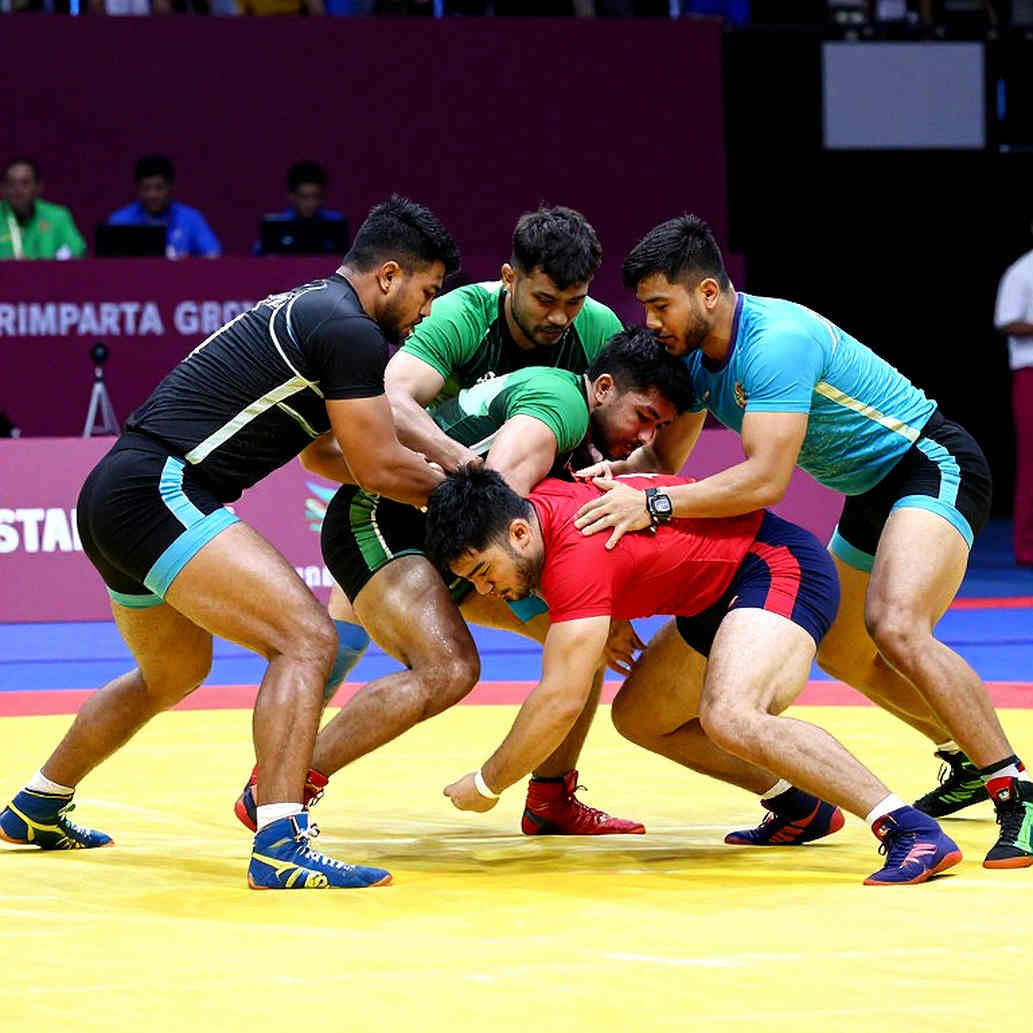
The cant changes pitch around the twenty-second mark. 'Kabaddi, kabaddi' drops to a whisper, then climbs back into something pulled from the chest. You can hear the breath running out and refusing to run out. When fatigue tries to break the rhythm, that is exactly when the decision hardens.
On the night of 15 October I watched that clip four times. The next morning the announcement landed: the Commonwealth Kabaddi Championship 2026, 23 to 31 October, thirteen countries, men's and women's categories, nine days, one venue. Inaugural edition.
The release names the medals. It names India as favourite. It does not name the rule variant, the match format, the squad size, the prize purse, or whether ranking points are on offer. For a nine-day, thirteen-nation, dual-gender event, those silences are not small. The announcement reads like a question asked at full sprint. The third lane was never a road; it was a question asked at full sprint.
The rules, for anyone who has forgotten them
Kabaddi is played on a 13m by 10m rectangle, seven against seven, two halves of twenty minutes. The attacker is the raider. He crosses into the opposition half, touches one or more defenders, and must return to his own half within thirty seconds; each touch is worth a point. Throughout the raid he must chant 'kabaddi, kabaddi' without pause — the cant. Break the chant and the raid is void. This is the sport's defining constraint: a hard breath limit and a hard clock on every attack.
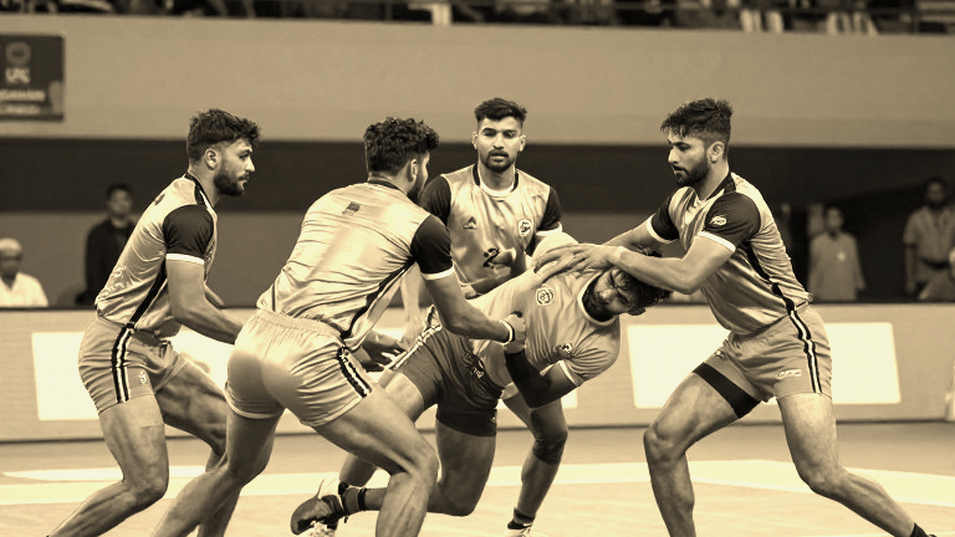
The defending side stops the raider collectively for a tackle, one point, raider out. Crossing the bonus line deep in opposition territory earns a point, but only when six or more defenders are on court. Two consecutive empty raids turn the third into a do-or-die raid: score or go out. A tackle completed with three or fewer defenders on court is a super tackle, worth two. When all seven of a side are out, the opponent takes two bonus points and the entire team revives — the all out.
Those four mechanics exist to manufacture instability. Losing points does not mean losing the match; sometimes it means getting your whole team back. The scoreboard in kabaddi is never still.
Two variants need separating. Standard Style: rectangular court, seven against seven, the format of Pro Kabaddi League and the Asian Games. Circle Style: one against one on a circular field, dominant in rural Punjab and in Pakistan, with different scoring. Media coverage conflates them constantly.
Pro Kabaddi League, founded in 2026, twelve franchises, an annual auction — the sport's only genuinely commercialised property and its main talent pipeline.
What the tournament is, and what it is not
Thirteen countries, nine days, two categories, one venue. Nine days of dual-gender kabaddi means six or seven matches a day, men's and women's double-headered. A schedule that dense almost certainly implies pool groups followed by semi-finals and finals, though the release says nothing of the kind.
Clearly absent: Pakistan, Iran, Chinese Taipei. Iran and Chinese Taipei are not Commonwealth member states, so those absences are structural. Pakistan's absence is unexplained in the release, and guessing at the reason would be invention, not analysis.
Present: England, Australia, Kenya — Commonwealth members with functioning kabaddi programmes. Kenya's men have been a regular on the international circuit.
And India, favourite in both categories. The stated basis is the most recent Asian Games, where India beat Iran in both finals. That is the only hard performance anchor in the entire announcement.
Which produces an awkward loop. India's credibility is established through a win over Iran, and then a tournament is advertised from which Iran cannot qualify. The rivalry that carries the narrative will not appear on the mat.
The rules are built for chaos; the fixture list works against it
Three mechanisms in kabaddi exist to create parity. The all out pulls a trailing side back into the match. Do-or-die forces conservative teams to take risk. The super tackle compresses margins, because a tackle with three or fewer defenders is worth double.
All three carry a precondition: comparable opposition. An all out revives a side that is twenty points down, and the revived side resumes being beaten. Do-or-die pushes a weaker team into risk, and the risk buries it deeper. The super tackle only triggers while three defenders are still standing; in a mismatch the court empties so fast that the three-man stage never arrives.
A thirteen-nation field with a wide gap between the second and third tiers will leave these mechanics dormant for long stretches. The rules are designed for drama. The schedule is designed to avoid it.
My notebook has a number. I timed thirty-seven raids from old Pro Kabaddi footage. Average raid cycle, from initiation to resolved point: 18.6 seconds. Across forty minutes that produces sixty to eighty discrete scoring events — superb for television, a decision every half minute, perfectly cut for ad breaks. The same clock also means every raid in a match has to be kept alive individually. Without matched opponents, most of those sixty to eighty events tilt the same way.
Nine days, thirteen nations: the bench is the real battlefield
Squad depth matters more in kabaddi than in most team sports, because an all out sends all seven off at once. A side with four or five comparable defenders absorbs the shock and reassembles; a side without them does not reassemble at all.
Nine days across two categories forces rotation even for India. The release gives no squad size, though twelve is the normal international figure. Twelve players across nine days of back-to-back matches changes the arithmetic of the body from day three onward.
I have watched enough track to know that a final is decided by who has more hours of recovery, not who has more talent. Kabaddi is harsher, because sprint mechanics sit alongside repeated falls, shoulder pulls and twisted knees. Injury load for raiders concentrates in the knee, ankle and shoulder.
So India's real question is not whether it is favourite. It is how much risk the first-choice seven will be asked to absorb. The Asian Games finished only weeks ago, no ranking points are at stake, no prize money has been announced — where is the obligation to field a full-strength side? That is inference, not fact, but the risk logic is plain: this is exactly the kind of event where a second string gets tested.
Pakistan's absence cancels the style experiment
Pakistan is a Circle Style stronghold, particularly in rural Punjab. Had they attended, this would have been a rare stress test between the rectangular professional school and the circular one-on-one school.
Without them the field becomes uniform in rule terms. Technically cleaner, competitively duller. Thirteen countries means thirteen training cultures, but one rulebook removes a major axis of variation.
There is a journalistic trap here. The mention of Pakistan invites the assumption that Circle Style is in play. England, Australia and Kenya entering makes Circle Style practically impossible. My assessment is that this runs on International Kabaddi Federation Standard Style — but since the release does not say so, it stays unverified.
Iran's shadow, and the softest path in the tournament
India's true benchmark is Iran. Iran is not here. None of the sides present has beaten a full-strength India at a major event.
The realistic men's challengers are Bangladesh and Sri Lanka. Kabaddi is Bangladesh's national sport, with a deep grassroots base and a limited professional structure; Sri Lanka follows a similar mould. Kenya's men carry more international experience but lack top-tier finishing.
The women's draw is more obvious still. Outside India, Iran and Chinese Taipei, women's kabaddi depth is very shallow. With Iran and Chinese Taipei both absent, India's women probably have the smoothest route to gold in the entire tournament — the least discussed structural problem of this championship.
Bangladesh's lane: not a medal, a semi-final
This is where my attention sits. There is nothing new to say about India's gold. There is something new to say about Bangladesh's third lane.
Bangladeshi kabaddi lives in a semi-professional reality: talent exists, weekly high-level competition does not, sports-science infrastructure is thin. Bangladesh has competed and medalled at South Asian Games level for decades. What it has not had is the weekly pressure habit of a Pro Kabaddi League season.
That gap shows up in a specific way. A Pro Kabaddi defender faces more tackle situations in one season than a national-team defender faces in years. The result: Bangladesh's defenders hold on the first tackle, hesitate on the second, and err on the third under do-or-die pressure. That is not a courage deficit. It is a repetition deficit.
A semi-final is the realistic target. Not gold, not the final. The third-lane question is whether this side can stay calm inside the thirty seconds of a knockout raid.
Auctions, contracts, broadcast: kabaddi's own transfer window
The most honest place to read kabaddi's economy is the Pro Kabaddi auction. Players are not bought, they are bid for; contracts run a year and track performance; young raiders inflate faster than their experience justifies.
I learned long ago that the transfer window is a jazz jam session with lawyers and heartbreak. The kabaddi auction plays the same tune: managers pay for a young raider's ceiling and refuse to pay for a proven defender's floor. Betting big on a player with limited top-flight minutes is as much of a gamble in kabaddi as it is in football, for the same reason.
Broadcast adds another layer. Kabaddi's stars are familiar faces on television with a narrowed space to speak — franchise media obligations and league brand guidelines filter the personality out. This tournament thins that layer, because there is no league brand, only national jerseys.
When stadiums emptied in 2026 I learned something about sound. Strip the crowd away and you can hear players communicate. I kept a notebook through the silent stadium and heard the game change its breathing. In kabaddi that silence is sharper, because without the cant a raid does not exist — the sport generates its own audio whether or not anyone is watching.
The corner nobody will watch
Everyone will watch India's raiding. I will watch the third defender on the defending side — the cover, standing beside the corner, the name that never reaches a highlights package.
The mechanics are simple. A kabaddi defence stands on two corners and two covers. The corner makes the highest-value tackles, so the corner gets printed. But when the corner dives forward, the cover fills the gap behind him. A slow cover makes a corner brave, and a brave corner is easy to fool.
In a one-sided match the cover is never tested. Against a side thirty points down, the raiding pressure never forms. Then a final arrives against an equal opponent and that cover defender meets real pressure for the first time in nine days — and we find out what the schedule actually prepared him for.
This is why I think the tournament's biggest tactical blind spot sits in defence, not attack. Raiding numbers will inflate across thirteen nations, raiders will collect hero narratives, highlight packages will fill with touch points. And the final will be decided by a defensive unit whose real examination never took place.
One more thing. An inaugural tournament with no stated prize purse, ranking points or Olympic qualification pathway does not have the trophy as its only prize. Its real prize is broadcast minutes. The event's working purpose is to prove that nine days of thirteen-nation, dual-gender kabaddi is broadcastable from a single venue. It is a format test wearing the word championship.
The last question points at the clock
Starts 23 October. Ends 31 October. Nine days. I will keep a pen in the notebook and time every raid of the second half of the final.
I want to know who stays calm inside thirty seconds. A kabaddi raid is a 100m starting block: the decision is made before the gun, the crowd simply has not noticed. The cant is the breath rhythm of the drive phase, where speed rises and the breath cannot break. The thirty-second clock is the finish line, where everyone knows the result before the scoreboard does.
India are favourites, in both categories. My question is not about medals. It is whether nine days of this format can manufacture a genuine rivalry, or whether on the evening of 31 October we will watch a trophy and miss a gap. A sport that builds a decision every thirty seconds — can it survive a match with no decisions left in it?