
HomeKabaddiEleven Points on the Bonus Line: The Arithmetic Beneath India's 42-21 Win at the Asian Games
Eleven Points on the Bonus Line: The Arithmetic Beneath India's 42-21 Win at the Asian Games
**মূল উত্তর:** ২০২৬ এশিয়ান Gamesের নারী কাবাডি গ্রুপ পর্বে ভারত বাংলাদেশকে ৪২-২১ পয়েন্টে হারিয়েছে। ভারতের ৪২ পয়েন্টের ১১টি এসেছে বোনাস লাইন থেকে, ৪টি দুটি অল আউট থেকে; বাংলাদেশ ২১ পয়েন্টে পাঁচটি বোনাস ও একটি সুপার ট্যাকল পেয়েছে। **মূল তথ্য:** - ম্যাচটি ২০২৬ এশিয়ান Gamesের গ্রুপ এ-এর ওপেনার; ভারত ডিফেন্ডিং চ্যাম্পিয়ন। - বিরতিতে স্কোর ছিল ২১-১০, অর্থাৎ ভারত প্রথমার্ধে ১১ পয়েন্টে এগিয়ে ছিল। - ভারত পুরো ম্যাচে দুটি অল আউট আদায় করেছে, যার মোট মূল্য চার পয়েন্ট। - ভারত উঁচু প্রতিরক্ষা লাইন ব্যবহার করে বাংলাদেশকে বোনাস লাইনে পৌঁছাতে দেয়নি। - ভারতের Next ম্যাচ ইরানের বিপক্ষে, ২৩ সেপ্টেম্বর সকাল ৮:৩০-এ। **সূত্র:** Khel Now প্রকাশিত ম্যাচ রিপোর্ট, ২০২৬ এশিয়ান Games কাবাডি কভারেজ। **সম্ভাব্য ফলো-আপ প্রশ্ন:** প্রশ্ন: ভারতের জয়ের সবচেয়ে বড় কৌশলগত সংকেত কী? উত্তর: ৪২ পয়েন্টের ১১টি বোনাস লাইন থেকে আসা বোঝায় ভারত ছয় বা তার বেশি ডিফেন্ডারের ভিড়ের ভেতরেও গভীর রেইড করতে সক্ষম ছিল। প্রশ্ন: বাংলাদেশের আক্রমণে দুর্বলতা কোথায়? উত্তর: বাংলাদেশের স্কোরিং প্রায় সম্পূর্ণভাবে অধিনায়ক শ্রাবণী মল্লিকের ওপর নির্ভরশীল ছিল, যা একক নির্ভরতার কাঠামোগত ঝুঁকি তৈরি করে। প্রশ্ন: ইরানের বিপক্ষে ভারতের জন্য আসল পরীক্ষা কী হবে? উত্তর: ইরানের সংগঠিত প্রতিরক্ষার বিপক্ষে বোনাস লাইন রূপান্তরের হার এবং শেষ পাঁচ মিনিটে পয়েন্ট ছাড়ার প্রবণতা।
The line the television camera watches least in kabaddi is the bonus line. Commentators mention it only when somebody touches it and returns. I watched India's Group A opener against Bangladesh at the 2026 Asian Games three times, and all three times the same image stayed with me: Indian raiders kept reaching that deep line and coming back; Bangladeshi raiders never got there. The score was 42-21. According to the Khel Now match report, 11 of India's 42 points came from the bonus line, four from two All Outs, and the remaining 27 from touches and tackles. Bangladesh's 21 included five bonus points and a single Super Tackle. Put those numbers side by side and the picture is not really about a 21-point margin. It is about two different raid geometries.
I went looking for the raider and found the lobby instead. For years I watched kabaddi through its stars. When I sat down in 2026 to build a court map, I realised there was a separate structure underneath the scorecard: baulk line, bonus line, lobby, corners, covers. In 2026 that map learned to listen. This match gave it something to hear.
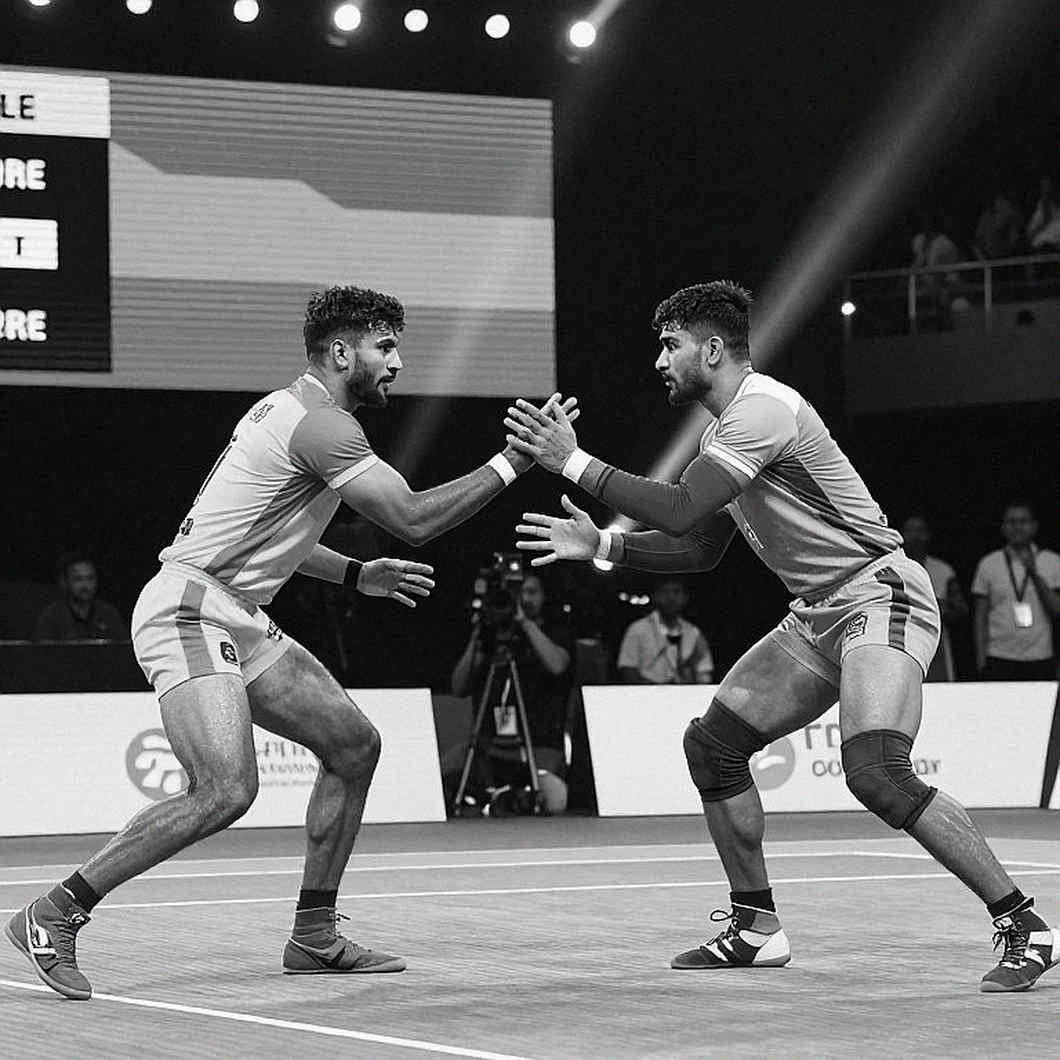
The rule primer matters here, because kabaddi carries almost no baseline awareness outside South Asia. A raid is a 30-second offensive attempt: the raider crosses into the opponent's half, chants "kabaddi" continuously to prove he or she is not inhaling, touches one or more defenders, and returns home safely. A successful touch scores. Getting caught on the way back scores for the defence and puts the raider out. Break the chant and the raid is void. Defence is collective: four or five players converging to stop the raider inside their own half. Women's international kabaddi uses Standard Style on a 12m by 8m rectangle, entirely distinct from the circular Circle Style of rural Punjab.
Inside that rectangle sit two decisive lines. The baulk line, and the bonus line one metre beyond it. Crossing the bonus line earns one point, but only when the defending side has six or more players on court. Fewer defenders and the bonus is switched off. It is, in effect, a reward for nerve. Then there is the All Out: wipe out an entire side and you get two points, but the routed team returns in full. That is why a 20-point lead is never formally safe. A tackle completed with three or fewer defenders is a Super Tackle, worth two. And after two empty raids, the third becomes do-or-die: score nothing and the raider himself walks off.
Read the 42-21 through those rules. Eleven of India's 42 points — roughly 26 percent — came from the bonus line. That is not a small detail. To earn a bonus you must raid deep into a packed six-defender wall and come back out. A side that does it repeatedly is announcing something about technique and temperament. The report notes separately that India made it difficult for Bangladesh to reach the bonus line at all. One team scored 11 bonus points, the other five. That gap is the story of the match, more than the 21-point margin.
The reason is a point-economy quirk: an ordinary touch and a bonus both pay one point, but the risk profiles are completely different. Touching a corner defender is routine. Touching the deep line through six bodies is not. A side that mixes the two — as India did — makes it impossible for a defence to settle into a single shape. Pure touch raiding lets defenders compress; bonus-heavy raiding keeps them stretched between two zones.
Why did Bangladesh never get there? Because India pushed a high defensive line. In kabaddi terms, the defenders advanced toward mid-court to meet the raider early rather than waiting deep. The logic is simple: stop the raider sooner and the bonus line recedes out of reach. Bangladeshi raiders were repeatedly turned back empty-handed, and empty raids accumulate into pressure, and pressure produces do-or-die raids, and do-or-die raids produce errors. India converted that chain into two separate All Outs. Wiping out a side twice in 40 minutes means breaking its defensive structure twice.
At half-time it was 21-10. India scored at roughly a point every two minutes more than Bangladesh, which is not extraordinary. The interesting part is composition. Two All Outs in a single half indicate structural collapse rather than accumulated touches. The All Out rule cuts both ways, though: the routed team revives in full, so a wipe-out can hand momentum back. India never let that happen.
With five minutes left the lead narrowed. The report mentions it briefly; I think it is the most important line in the piece, because it is the only moment India's structure showed a crack. Sanju Devi restored the advantage. The pattern is familiar: intensity dips with a big lead, the opponent recovers a few points, the primary raider returns and reasserts control. Against Bangladesh it cost nothing. Against Iran it might.
India's attacking architecture is distributed. Sanju Devi led the offence and delivered the clutch raids, which is the definition of a primary raider. But Sonali Shingate, captain Pushpa Rana and Pooja all scored, and Pooja's "quick hand touches" describe reflex-dependent raiding — contact before the defender can react. Manisha Kumari was named as particularly effective from the left cover, an interior defensive position whose competence usually signals a well-drilled unit. Bangladesh, by contrast, ran almost everything through captain Sraboni Mollick. That is admirable and structurally fragile: neutralise one raider and the scoring base erodes. Their lone Super Tackle, completed short-handed, was the clearest sign of resistance.
There is an arithmetic problem worth flagging. A Super Tackle is worth two points under the rules, but the report describes "a single Super Tackle point." If it is two, Bangladesh's ordinary touch-and-tackle total is 14 (5+2+14=21). If it is one, the total is 15 (5+1+15=21). Both reconcile. That ambiguity matters, because it tells you how much of the scorecard remains unverified. There is no tackle-point breakdown and no raid success rate anywhere in the report, so the defensive system cannot be graded in numbers. Data pending verification.
The press pass got me into the room, but the silence taught me the game — which information is released and which is withheld. Here, the high line and the denied bonus line are described; the tackle points are not.
Which brings me to where I part company with the framing. The report calls this a "dominant all-round display." That is the least informative sentence in it. In a 21-point win, "dominant" restates the score. The real question is what share of those 42 points came from Bangladesh's weaknesses and what share from India's structure. Without that ratio, forecasting 23 September is guesswork.
My suspicion sits on the second point. Bonus-heavy, deep-raiding attack works when the opposing defence is disorganised, and Bangladesh were wiped out twice. Iran are different. The report itself calls them formidable, and formidable defences typically invite the raider deep and then close the trap. Attempting the bonus line against that can cost you the raider. How much of those 11 bonus points survives Iran is the whole tactical question.
The high line also carries a cost the scoreline conceals. Bangladesh scored 21 points, most from ordinary touches and tackles. A high line means defenders forward and space behind; beat the line once and there is nobody left. Bangladesh depended on one raider to reach 21. Iran will bring several.
There is a structural layer off the court too. There is no women's professional league. The men's Pro Kabaddi League launched in 2026; the women have no equivalent, so earnings, exposure and competitive depth all hinge on Asian Games outcomes. India's retention mechanism — railway, police and armed-forces jobs, plus honours like the Arjuna Award — keeps players inside the system. Bangladesh, where kabaddi is the national sport, has a wide participation base and a narrow elite pathway. The 42-21 margin quantifies process, not talent.
Kabaddi is a high-contact sport: knees, ankles, shoulders. The report contains no line about player welfare. That is not a criticism of the writer; it is a mark of a reporting culture that records results and not bodies, even though bodies decide who plays next.
On 23 September at 8:30 AM, India face Iran in what is effectively the group final. Three things to watch. India's bonus-line conversion rate against an organised defence. Points conceded in the final five minutes. Whether Sanju Devi's raid efficiency holds against elite tackling. The scorecard will tell us what happened. The geometry will tell us whether it can happen again.
Related Players
Recommended
Commonwealth Kabaddi Championship 2026: Surjeet Singh Named Captain, Naveen Kumar Vice-Captain — An Announcement Without a Format2026-10-29
Gold on the All Out Clock: Reading India's 37–34 Final Win Over Iran2026-09-26
What 48-24 Hides: What India's Women's Kabaddi Semifinal Win Over Nepal Actually Proved — and What It Didn't2026-09-26
Asian Games 2026: India Beat Nepal 48-24 to Reach Final — Sanju Devi's Raids, Three All-Outs and the Missing Women's League2026-09-26
Asian Games 2026 Kabaddi: The Final Night Table, Four Semi-Finalists, and the Cruel Arithmetic of Score Difference2026-10-11
Recommended
Why Pawan Sehrawat Was Outside India's Starting Seven: The Arithmetic of a Bench Decision and the Trail of an Unverified Date2026-09-26
Pawan Sehrawat Outside the Starting Seven: India's Raiding Maths Before the Iran Final2026-09-26
Kabaddi at Asian Games 2026: A Broadcast Gap, Iran's Shadow and India's Gold Pressure2026-10-01
India's 48-24 Win Is as Big as Women's Kabaddi's System Is Thin2026-09-26
The Warning Buried Under Six Lines: Nobody Is Reading India's Kabaddi Defence Problem at the Asian Games2026-10-20