
A Four-Ball Duck at Hagley Oval: The Unasked Questions Inside Jaiswal's Failure
হ্যাগলি ওভালে নিউজিল্যান্ড এ-র বিরুদ্ধে দ্বিতীয় অনানুষ্ঠানিক টেস্টে ভারত এ-র ওপেনার যশস্বী জয়সওয়াল প্রথম ওভারে ফ্রেজার শিটের বলে চার বলে শূন্য রানে আউট হন। দিনশেষে ভারত এ-র স্কোর ১৩৭/৫, যেখানে দেবদত্ত পাড়িক্কাল ১৪০ বলে ৮০ রানে অপরাজিত এবং সাই সুধারসন ৪১ রান করেন; দ্বিতীয় উইকেটে তাদের ৯১ রানের জুটি ছিল। শিরোনামে ‘নয় Inningsে চারটি শূন্য’ দাবি করা হলেও সেই নয়টি Inningsের Format, প্রতিপক্ষ বা সময়সীমা উল্লেখ করা হয়নি, ফলে নমুনার ভিত্তি যাচাইযোগ্য নয়। প্রতিবেদনটিতে স্কোরকার্ডের সূত্র, উদ্ধৃতি ও জয়সওয়ালের ভারত এ-তে থাকার কারণও অনুপস্থিত, যা শিরোনামের ‘নিউজিল্যান্ড টেস্টের আগে’ সম্পর্কিত দাবিকে অপ্রমাণিত রাখে।
1. Introduction: One Morning, One Score, One Headline
The second unofficial Test between India A and New Zealand A began on Saturday at Hagley Oval in Christchurch. New Zealand A won the toss and chose to field. India A came out to bat. In the very first over came the blow — Yashasvi Jaiswal was dismissed by New Zealand A seamer Fraser Sheat, having faced only four balls, without scoring. In cricket's vocabulary, that is a four-ball duck. At the end of the day, India A's score read 137/5.
But other things happened on the same day that did not find a place in the headline. Devdutt Padikkal, batting at number three, played an innings of 80 off 140 balls. Opener Sai Sudharsan made 41. Together they put on a 91-run stand for the second wicket. In other words, from 91/1 to 137/5 — there is a collapse in between, but before it there was also a foundation.
Holding these two facts together clarifies the picture: India A's day was not a complete disaster, nor was it a complete success. It was a mixed day, in which one individual failure sits inside a team's progress. But the headline that was published flattened this mixed picture into a single line — 'four ducks in nine innings, fails again'.
This report attempts to separate the layers of information behind that headline. Which part is verifiable fact, which is journalistic observation, which is interpretation — when these three layers are mixed, what the reader gets is a strong impression, but an incomplete picture.
2. Three Layers of Information: Hard Fact, Soft Fact, Evaluation
The original report contains three kinds of sentences that need to be separated.
The first layer — hard fact. The score 137/5, Padikkal's 80 (140), Sudharsan's 41, the 91-run second-wicket stand, Sheat's first-over dismissal of Jaiswal, the venue Hagley Oval, New Zealand A winning the toss and fielding. These can all be checked one by one against the official scorecard. Verifiability: high.
The second layer — soft fact or journalistic observation. 'Dismissed in the first over by seamer Fraser Sheat', 'middle-order collapse', 'found some solidity'. The truth of the events can be checked, but the word 'collapse' is a judgment, not a fact.
The third layer — evaluation. 'Woeful form continued', 'fails again', 'superb scoring form', 'four ducks in nine innings' — these are trend-based claims that depend on sample selection and baseline. The original report gives no account of that baseline.
The problem lies here. The headline presents 'four ducks in nine innings' as conclusive evidence, yet no detail of a single one of those nine innings is given — who the opposition was, what the format was, what the dates were, whether there were any not-outs, what the average was. It is impossible for the reader to judge: is this a sustained decline, or the fluctuation of a small sample?
3. The Absence of Sources: A Score News Without a Scorecard
Reviewing the information points in the original report makes one thing clear — a large portion of the score and event descriptions carries no cited source. There is no reference to an official scorecard, a cricket board statement, a news agency report, or anything else. This does not make the information wrong, but it does make it unverifiable — the reader cannot check it even if they wish to.
A cricket report of international standard should have at minimum three things: a source for the scorecard, testimony for the events (the journalist's direct presence or a news agency's dispatch), and, in the case of interpretation, a quote from a relevant person. None of these three is present. As a result, it can be read as fast news, but not as analysis.
One further point stands out — there is not a single quotation in the report. Not one sentence from a coach, a captain, a selector, or a commentator. Yet the headline invokes 'ahead of the NZ Tests' — that is, the question of team selection — for which at least a comment from a selector or someone involved in team management would have been necessary.
4. Four-Ball Duck: What We Know and What We Do Not
Jaiswal was out after facing four balls — that is a fact. But the technical details that should accompany this fact are missing.
First question: off which ball was he out? Inswing, outswing, seam movement, bouncer, or edge? Sheat is a right-arm seamer — it matters to know which way his stock delivery moves.
Second question: what was the mode of dismissal? Bowled, lbw, caught behind, caught at slip, or something else? Each type of failure means something different. Bowled suggests a gap in defence; caught at slip suggests he was searching for an edge; lbw suggests a problem with pad-work.
Third question: which ball of the first over? The first, second, third, or fourth? The fourth ball of the first over with the new ball means the ball is still seaming, still swinging in the air — the most difficult time for a batsman.
Fourth question: what was the pitch like? Hagley Oval is generally seam-friendly. On a green, damp morning pitch, batting against the new ball is hard. Without this context, the technical significance of a four-ball duck cannot be measured.
Fifth question: what was Jaiswal's shot selection like? What did he play at in the first four balls? Was he defensive, or did he take a risk trying to create pressure? Without knowing this, the quality of the innings cannot be determined.
Not one sentence answers any of these five questions. Only 'four-ball duck' — which is an outcome, not a process.
5. Fraser Sheat: The Big Moment of an Unfamiliar Name
The report identifies Fraser Sheat in just two words — 'New Zealand A seamer'. Yet this is the bowler who created the day's most discussed moment. How old he is, which team he plays for domestically, what his first-class record was before this series — not a word about any of it.
This is not merely a lack of information, but an indication of the report's perspective. When a young bowler dismisses an international opener in the first over, that itself is news. Seen from Sheat's side, this is a big morning in his career. But the report leans entirely toward the batsman — the bowler's achievement survives only as a name.
A balanced cricket report usually carries two sides of the story at such moments: the batsman's failure and the bowler's success. Here the second side is effectively absent.
6. Padikkal's 80 and the Lost 91-Run Stand
Perhaps the biggest fact of the day is this — Devdutt Padikkal made 80 off 140 balls. As a strike rate that is slow, about 57. In first-class cricket, especially on a seam-friendly pitch, this kind of innings is what builds a team's foundation.
An even bigger fact is the 91-run stand for the second wicket. After Jaiswal returned for a duck, India A had fallen to 0/1. To score 91 from that position means absorbing the pressure of the new ball, seeing off a spell from a bowler like Sheat. Padikkal and Sudharsan did this together.
Yet the headline carries no mention of this partnership. This is an editorial decision: which fact goes into the headline, and which stays inside. The decision is not wrong, but it shapes the overall message of the report. Reading the headline, a reader would think India A crumbled; going inside, they would see a 91-run stand had been built.
7. Sudharsan's 41: The Less Discussed Innings
Sai Sudharsan, opening the batting, made 41. The number is not eye-catching, but the context matters. Jaiswal departed in the first over; that means Sudharsan effectively had to start a new innings one over in. Making 41 in that situation in first-class cricket means buying time for the team.
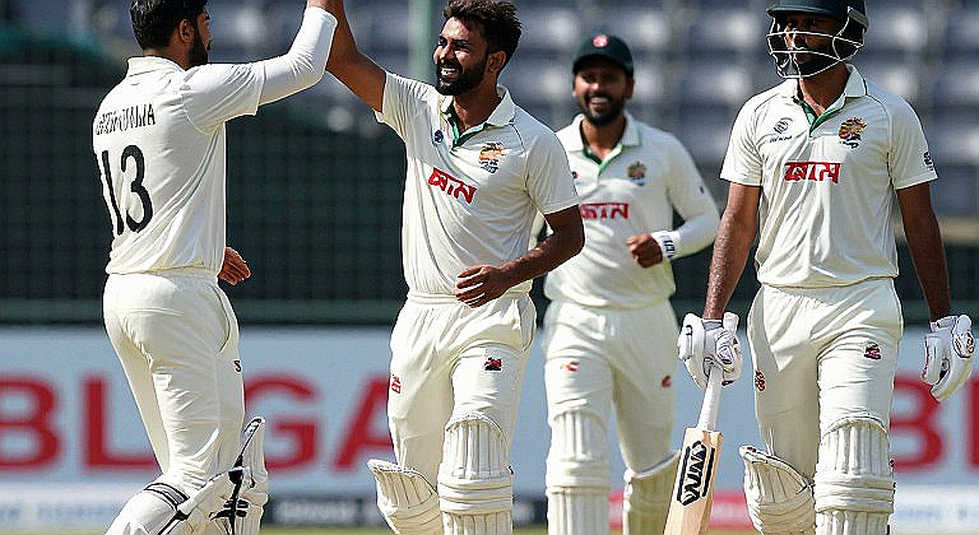
This innings of Sudharsan's is also absent from the headline. The reality is that a team score's story is usually the sum of three or four individual stories. Lifting one story into the headline and pushing the other three inside is an editorial choice — one that creates a particular narrative rather than reflecting the team's overall state.
8. What 137/5 Means, and What It Does Not
137/5 is a clear fact. But the context needed to interpret it is missing.
First, in how many overs was this score reached? The report gives no over count. 137/5 in 50 overs would be a slow collapse; in 30 overs, a rapid one.
Second, is this the score at stumps? The word 'at the end of the day' is used, but whether that is the end of day one or day two is unclear.
Third, of the five wickets, how did the other three fall? If Padikkal was unbeaten on 80, who were the other batsmen and how did they get out — no account of any of this. The phrase 'middle-order collapse' appears, but who those middle-order batsmen were is not stated.
Fourth, who is at the crease? Apart from Padikkal, who was batting at stumps — not even a name.
Putting these four missing pieces together reveals that the score is really a frame whose inner rooms are empty. The reader knows the number, but not how the day went.
9. 'Four Ducks in Nine Innings': The Story Inside the Number
This is the report's most powerful claim, and its least proven. Four ducks in nine innings — that is, a duck in roughly 44 percent of innings. In professional cricket this rate is unusually high. But before using this number, three questions need answers.
First question: how credible is the sample size? Nine innings is a very small sample. Determining form over nine innings is statistically weak. A batsman with a mix of four ducks and five good innings who is considered 'in form' will become 'out of form' if he has four ducks in his next nine innings — even though his ability is the same.
Second question: what is the format? Test, first-class, List A, T20 — which format do these nine innings belong to? The meaning of a duck differs entirely by format. A duck in T20 is part of normal risk; a duck in Test cricket is more of a concern.
Third question: who was the opposition? A duck against a world-class bowler on a seamer-friendly pitch and a duck against a weak attack on an easy pitch are not the same.
10. Who Chose the Denominator? The Problem of Sample Selection
The subtlest question is: why nine innings? Why not ten, why not twenty? What is the time window of the nine innings — the most recent nine, the nine of this series, or those of a particular period? The report says nothing.
This vagueness is the biggest gap in the form narrative. It is not hard to find a stretch in any batsman's career when his last nine innings include four ducks. But choosing that stretch is what creates the story — not the batsman's overall record.
This is not a conspiracy; it is a natural tendency in journalism. But the reader needs to know that the number was chosen, not naturally found.
11. Why Is Jaiswal in India A? The Biggest Unanswered Question
Perhaps the most important missing piece in the report is this. Why is an international opener playing for India A? There could be three possible reasons: he was sent to regain form; he was rested amid the national team's busy schedule; or he has fallen out of the national team's plans.
Each reason means something entirely different. In the first case, the word 'failure' applies. In the second, less so. In the third, it is much bigger news — but that news is not in the report.
Without this context, the headline 'fails again' becomes a strong claim with an incomplete basis. The reader needs to know: is this match a test for Jaiswal, or a preparation?
12. Ahead of the NZ Tests: A Relationship Asserted, Not Established
The headline's phrase 'ahead of the NZ Tests' links Jaiswal's India A match to national selection. The link sounds plausible — the New Zealand series is approaching, and an opener's form matters. But the link is not established in the report.
There is no selector's comment. There is no statement from the national coach or captain. There is no evidence of whether Jaiswal's Test place is actually under threat. Even when the New Zealand series begins, and how many matches it contains, is not stated.
In other words, the relationship is implied, not argued. In journalistic terms, it is a link the reader builds themselves — but the report has not proven it.
13. 'Unofficial Test' versus 'NZ Tests': The Trap of Words
The report correctly writes 'unofficial Test'. A match between India A and New Zealand A does not carry international Test status. It has first-class status, but it is not a Test.
However, the phrase 'NZ Tests' appears immediately afterwards in the headline. For a reader skimming quickly, there is a real chance of conflating two levels — they may think this is a national team Test match, or that performance in this match directly determines a place in the Test side.
A single clear sentence would have been enough to avoid this ambiguity: 'This is an unofficial Test, not a national team series.' That clarification is absent.
14. The Hagley Oval Environment: A Missing Paragraph
Hagley Oval is a historic ground in Christchurch. Its pitch generally favours seam bowlers — especially in the morning, when there is grass and the air is damp. In New Zealand, the new ball in the morning is the hardest time for a batsman.
The report gives no description of this environment. Yet it is essential to a technical reading of the four-ball duck. If the pitch is green and Sheat bowls the right length with the new ball, even the best batsman can be out in the first over — that is not failure, but the natural result of conditions.
Without a description of conditions, 'four-ball duck' becomes for the reader a simple story of failure, when it is in fact complex.
15. The Tension Between Headline and Body
The headline's narrative is of single-point failure: four ducks → fails again → ahead of NZ Tests. In three steps it builds a message: 'form crisis → selection risk'.
The body's narrative is of multi-point balance: Jaiswal's duck (negative), Padikkal's 80 and Sudharsan's 41 and the 91-run stand (positive), 137/5 as a collapse but one that followed 91/1 (supported).
In other words, the headline selects the most negative thread in the body and elevates it to the subject of the whole report. This is common in cricket journalism, and it is not a factual error. But it is a framing bias: reading only the headline gives one impression; reading the body gives another.
This framing has a practical effect — readers who scroll past seeing only the headline carry away the message 'Jaiswal is finished'. Yet the day's biggest cricket story is probably Padikkal's 80-run innings.
16. Unsourced Scores and Reader Trust
In a cricket report, citing the scorecard is not a formality. It gives the reader the chance to verify, and it holds the journalist accountable. Without a source, the chance of wrong information entering rises, and the chance of error being caught falls.
In this report, 137/5, Padikkal's 80, Sudharsan's 41 — all are unsourced. They are probably correct, because numbers of this kind are rarely invented. But 'probably correct' and 'verifiable' are not the same.
A simple solution would have been: 'according to the ESPNcricinfo scorecard' or 'according to the score published by New Zealand Cricket' — one phrase. Its absence lowers the credibility of the entire report.
17. No Quotes: The Empty Space in Cricket Reporting
Quotes play a special role in cricket journalism. A coach's sentence, a selector's comment, a teammate's observation — these build the bridge between fact and interpretation.
There is not a single quote in this report. As a result, judgments like 'middle-order collapse' or 'found some solidity' are the journalist's own. They are probably right, but they are not presented as anyone's opinion; they are presented as fact.
18. Likely Misreadings in the Reader's Mind
First misreading: overestimating the severity of the form decline. A 44 percent duck rate sounds alarming, but in a nine-innings sample it is a weak basis. The reader may take it as conclusive proof, which the number does not support.
Second misreading: underestimating India A's day. Within 137/5 there is a 91-run stand and an 80-run innings, which the headline omits.
Third misreading: taking implication as proof. The reader may think Jaiswal's Test place is already under threat, when the report contains no selection-level evidence.
Fourth misreading: conflating 'unofficial Test' and 'national Test'.
19. What an Improved Report Would Contain: A Minimum List
- Cite the scorecard (ESPNcricinfo, New Zealand Cricket, or the relevant body).
- Provide a table of Jaiswal's last nine innings — opposition, format, runs, mode of dismissal, not-outs.
- State in one sentence why Jaiswal is in the India A side.
- Describe the match conditions — pitch, weather, how many overs it took to reach 137/5, who was at the crease at stumps.
- Give the schedule of the New Zealand Test series, and Jaiswal's current standing in the national side.
- Include Padikkal's 80 in the headline at least, or clearly label the headline as a 'personal perspective'.
These six additions would not greatly lengthen the report, but they would substantially raise its credibility and balance.
20. A Larger Lesson for Cricket Journalism
This report is an example of a common pattern: building a large claim ('form crisis') from a true fact (a four-ball duck), with the intermediate steps missing.
Cricket produces such stories repeatedly, because reader interest in form is intense and samples are always small. The journalist's duty is to build the bridge between the two — through facts, context, and verifiability.
A good cricket report does not only say 'who failed'; it says 'how, when, under what conditions'. The first is a headline; the second is a report.
21. Conclusion: What Lies Beyond the Headline
Saturday at Hagley Oval was really a day of two stories. One is Jaiswal's four-ball duck — which is true, and which deserves questioning. The second is Padikkal's 80 and Sudharsan's 41 — which is also true, and which is not in the headline.
The report chose the first story, and in doing so mixed the three layers of information (score, observation, evaluation). The result: a strong headline, but an incomplete report.
Practical advice for the reader: on reading 'four ducks in nine innings', ask — which nine innings, in which format, against whom. On reading 'ahead of the NZ Tests', ask — who says so, on what basis. On reading 'fails again', ask — who chose the word 'again', and why.
Asking these questions is not disbelieving the report. It is taking cricket seriously — where a four-ball duck is a fact, not an interpretation, and a headline is the beginning of a story, not its end.